Coal miner strike nears one month in Bogota

DSC_0003

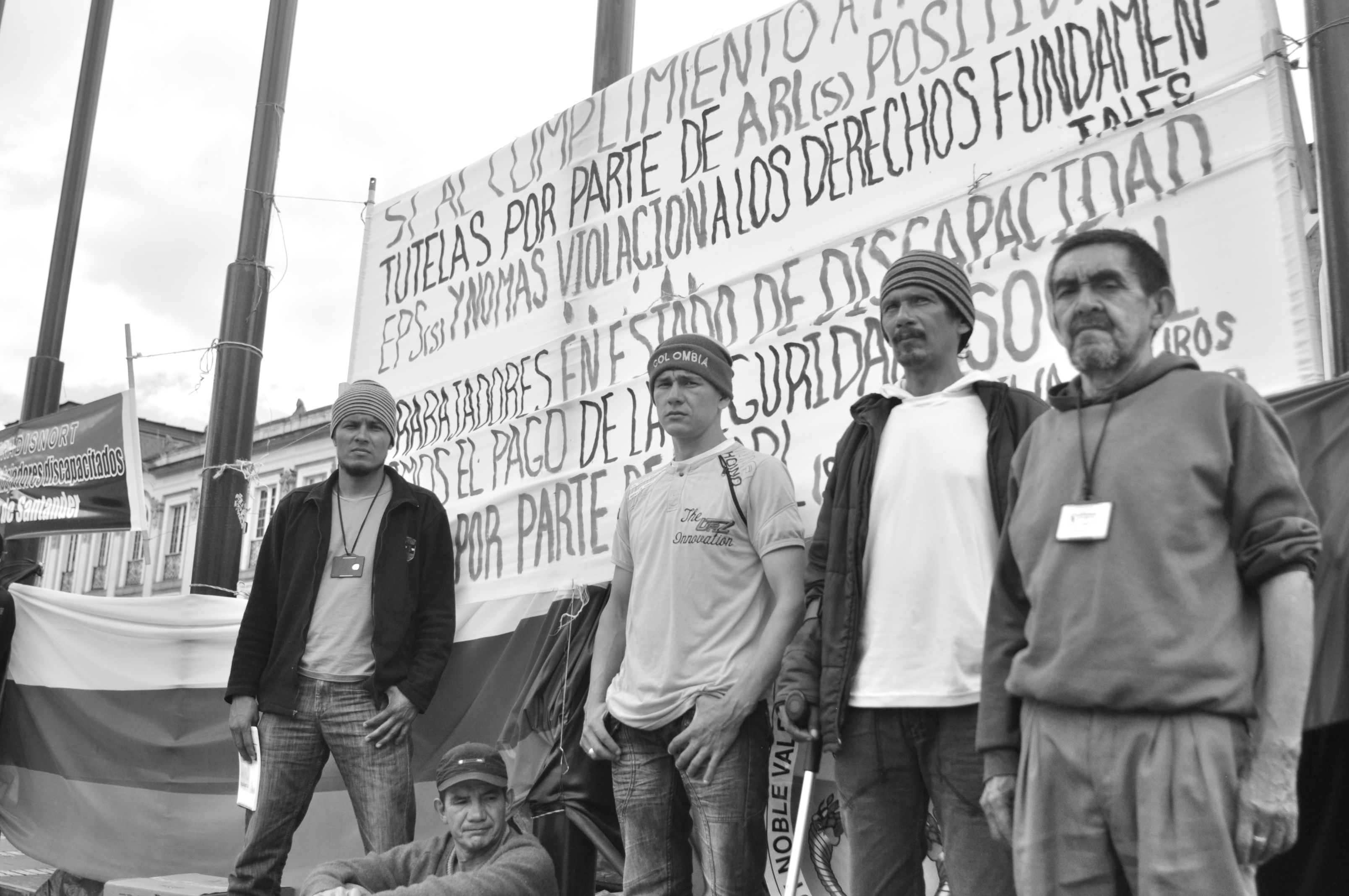
On the edge of Bogota’s central plaza there are a row of tents covered by black tarps. This is where coal miners from Colombia’s Norte de Santander region have been striking in Bogota’s main plaza, Simon Bolivar, for nearly a month.

The men are protesting the failure of the state to provide them with compensation for accidents on the job.

Spokesperson for the strikers, Farley Rodriguez Ramirez, told me on Monday that when he went to the Administration for Work Risks in Bogota to seek help, he was treated violently and did not receive services.

“The police even stole my phone,” said Rodriguez.

Malpractice

Some of the miners have received treatment. One miner pulled up his shirt and showed me a long scar that ran down his spine, showing where he had received a surgery that corrected a work injury.

But the miners claim that the surgery was poorly done, and the miner will not be able to return to work.

Strikes cost a lot

On August 19th, coffee farmers, truck drivers and miners across Colombia executed strikes in an effort to press the Santos administration for more attention to what many workers believe are broken institutions behind big government promises for reform.

Coffee farmers, who negotiated funds to help subsidize their falling incomes, understand that the funds the government promised have enough money. But they claim they cannot access them.

A study published by Bogota-based think tank ANIF found that Colombia’s strikes cost the country’s economy around $470 million.

Interview with Martin Olaya, Student Peace Marcher

April 2013 – “Peace means a stop to the people dying in hospitals, the poverty in Colombia and the children suffering from hunger.”

That is what student Martin Olaya yelled above the din as he hustled through a crowded street in Bogotá during a peace march where thousands of Colombians were estimated to have taken to the streets in support for the peace talks between the Colombian government and FARC guerrilla in Havana.

On the way to the Ministry

February, BOGOTÁ – My driver suddenly lurched and made a hard right off the Caracas and into the heart of the Zona Tolerancia, into the streets of the whores. Into the crumbling concrete towering around us. Over cracked pavement and rubble. Past fat ones and black ones. Past fat black ones and sad fat ones. The saddest part is when their tits just hang out and stare blankly at you. And some whores – they don’t stand. They just sit. They sit in broken chairs and watch out from the door-less doorways. Are they really hoping you’ll stop for a visit? Probably. I mean, probably, right?

Señor… We’re going to the Ministry, right?” I asked, leaning forward, doubting his turn into Bogotá’s Zona Tolerancia, the zone where drug use is rampant and prostitution is legal and regulated, where the sadness and desperation of the whores and the blank men who roam the streets peeking at them is painfully visible, where I didn’t want to be.

“This is the way to the Ministry,” he said plainly. He didn’t even looked at me through his rear-view mirror.

Maybe my driver just wants this to be the way to the Ministry, I thought to myself.

I tightened my tie, tried to feel formal, and reviewed the address again.20120729-_DSC0072

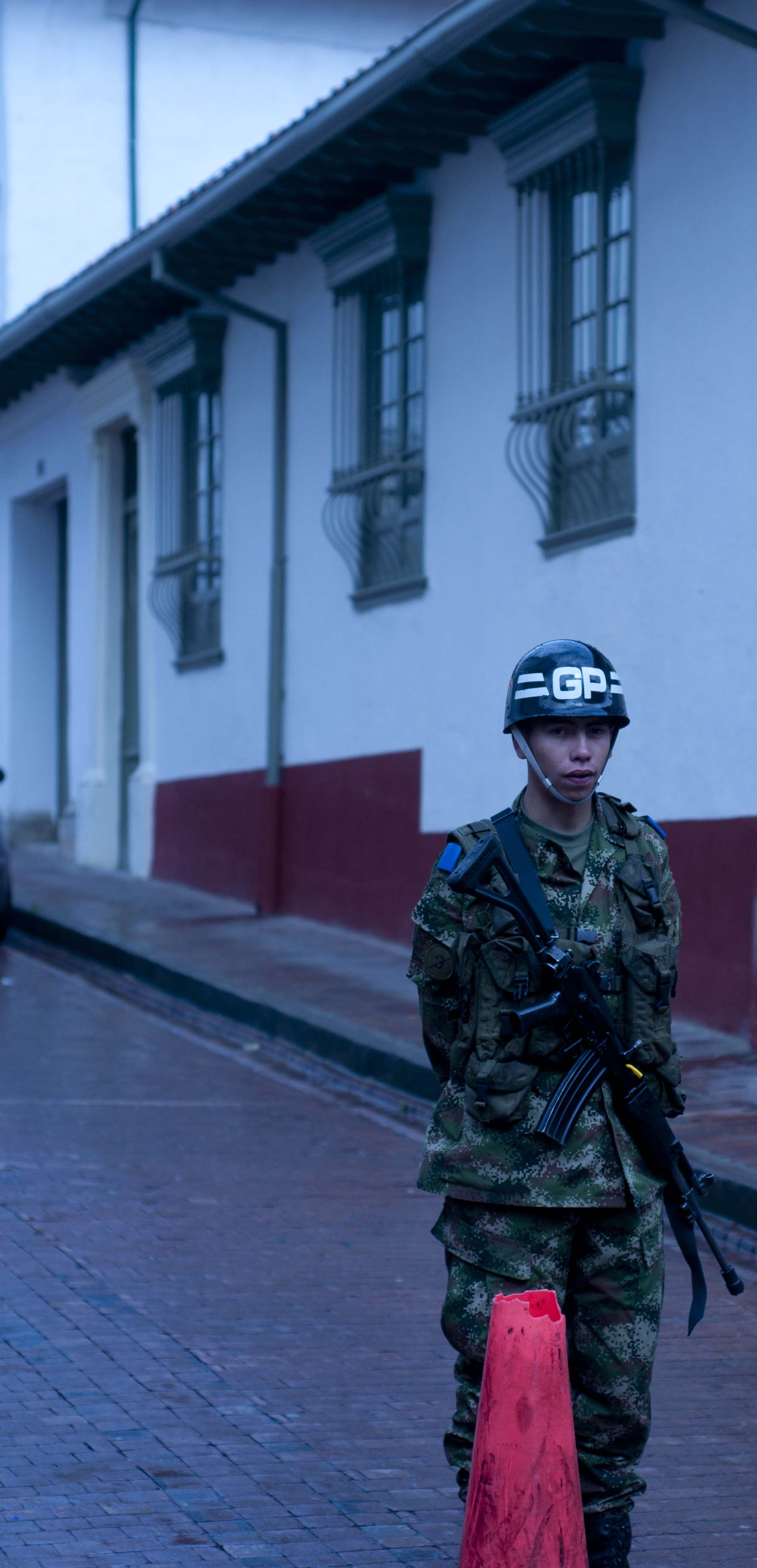
When I got to the Ministry buildings, there were soldiers with automatic rifles stationed on the corners. I walked down a cobblestone street. The Presidential office Casa Nariño spread out in front of me. More soldiers, this time with bayonets pointing up into the sky at a sharp angle, marched in formation about the green on the other side of a tall gate. At the Ministry of Finance, I registered. They took a photograph of me. And then the elevator took me up.

It is easy to draw conclusions. It is easy to see tired old whores and say that they are sad. It is easy to see men roam and say that they are desperate. And it is easy to see heavy black sub-machine gun rifles and conjure up opinions about security and how much money is spent and it shouldn’t be spent and how safe you really are in the middle of all of this. But these are just symbols. Not truths. And symbols should be the fount of questions. Not close-ended conclusions. Concluding, not asking, is a mistake that is dangerous and so easy to make.

It takes discipline to ask.

The elevator lets me out. There is no sound. It is as if suddenly the noise of the street of the whores might be totally forgotten in a place like this. I wonder if it really is? Sometimes I really feel like asking questions like these.

Inside a plain, white-walled office there are three desks and three people waiting for me. They make up a perfect formation. The man stands. The women sit. They are all staring at me. Their faces are stone, but their words are cordial.

I introduce myself, we chat, we trade contacts, and then I thank the older lady. I use the usted form. Formality. This is the Ministry of Finance, after all. My assumption is that formality comes first.

“Ximena, please,” she says to me in return, killing my usted. Our hands are clasped in a shake when she says it. She gives me a thin smile.

“Ok, Ximena,” I say.

And then I leave, out the way I came. And the elevator has its way with me again. And I descend, out through the doors, and finally I’m back on the streets and the cobblestones make noise as I trod across the government grounds. A homeless man catches my stare and reaches out his hand. I hurry past. My face tightens, like always, when that pleading, desperate, filthy hand reaches out and begs me for coins. Just a few coins. Please, Señor! But who knows what he’ll do with my money? Right? I mean, right? It’s impossible to assume he’ll use them to eat. This is a hard thing to do. Sometimes it hurts. But it’s better: make no assumptions.

UK, Colombia strengthen ties in education, infrastructure, development

April 23rd, BOGOTÁ – (Colombia Reports) – Top British and Colombian officials on Monday celebrated a new partnership that promises to strengthen ties in higher education, science and business.

Colombia’s recent economic transformation, coupled with better security and a prospect for peace has ushered in a wave of trade interest from other countries. A British mission led by Minister of Universities and Science David Willetts brought optimism for Colombia’s future, as well as prospects for increased trade between the two nations.

“We have been looking on with great respect and admiration at the transformation of Colombia in the past years as Colombia becomes a modern, liberal democracy,” Willets told a packed roomful of Colombian business leaders, policy makers and officials. Continue reading at Colombia Reports…

Cartagena’s Getsemani neighborhood, alive with new transformations and old charms

April 17th, CARTAGENA (Colombia Reports) – As parts of the Getsemani transform, this once dangerous and seedy neighborhood in Colombia‘s port city of Cartagena still keeps its stubborn, extraordinary charm alive.

A barefoot man sweating bullets from his shirtless back pushes a cart caked in blue peeling paint down a cobbled stone street inside the walled city of Cartagena’s old town. The cart’s three metal wheels shake and shiver until finally the man stops for a rest to fight against the oppressive heat that so defines Colombia’s coast. The barefoot man and his rickety cart, loaded with miscellaneous goods — often with odd things like bricks, scrap metal, even tangles of yucca root — are a staple of Cartagena’s old town, a relic of the past which has stubbornly remained a constant since colonial times.

 Cartagena's Getsemani neighborhood  Cartagena's Getsemani neighborhood  Cartagena's Getsemani neighborhood  Cartagena's Getsemani neighborhood  Cartagena's Getsemani neighborhood  Cartagena's Getsemani neighborhood

Cartagena’s Getsemani neighborhood sits nestled inside the south-east corner of the city’s ancient walled fortress, a beautifully preserved colonial district, whose architecture has earned itself a place among UNESCO’s list of world heritage sites. Traditionally a gritty, working class neighborhood, it was once recently burdened with a reputation for thieves, prostitutes, and drug dealers. Recently however, the neighbourhood has undergone a resurgence, and such unsavory elements have been pushed to the fringes. What remains is the grittiness of the locals, and the faded grace of the neighbourhood’s worn out pastel facades, which still exhude a dilapidated charm into the lives of travelers who wander through. The change has not gone unnoticed by backpackers, many of whom find the neighborhood to be a refreshing change over Cartagena’s more touristy neighbourhoods, like Bocagrande.

It’s not hard to see why, as Getsemani is a feast for the senses, alive with colour and vitality. On a street corner, beads of sweat fall off the faces and bare backs of two men selling empanadas that are as spicy as the tropical juices sold alongside them are succulent. Their clients, a hungry crowd whose members lounge on a cracked concrete curb across from a worn yellow church, are a mix of Europeans, Americans, Colombians, Australians, Venezuelans and Italians — these old street vendors don’t discriminate.

Beyond strolling the beauty of Getsemani’s streets by day, travelers will find the neighborhood’s nightlife to be equally vibrant, fuelled by a delicious mix of cocktails and humming with a heady mix of music and dancing. Café Havana (Calle de la Media Luna con Guerrero; 57-310-610-2314; cafehavanacartagena.com) is a Latin jazz café dripping with atmosphere. Live music performances start late, and the place fills up fast, but the mojitos are rumored to be some of the best in the city. Others, like the Bazurto Social Club (Avenida del Centenario Carrera 9,30-42), a place named after a nearby rambunctious market, lets your ears and body feast on traditional cumbia music to Afro-Colombian sounds from the 70s.

While you wait — nightlife starts late in the Getsemani — there’s no better place to relax than the stone steps that spill out onto the plaza in front of the Parroquia de la Santisima Trinidad church (Carrera 10 with Calle 29). This is where the people of Getsemani come to meet each other, where children play games of pick-up soccer, musicians serenade their lovers with their fast, intoxicating ballads, and lazy grandmothers station themselves on park benches to keep track of the throng.

The next morning, hip joints like Ceiba Juice Bar (Calle Guerrero 29-75; 57-310-660-4114), where fresh tropical juices are hand made and the coffee is reminiscent of tight Italian-style ristretto, will revive you once again. Horacio Perez, Ceiba’s owner, is Colombia’s only wholesale vendor of Acai berry. You can get wifi with your acai here as well.

Accommodation is easy. Hostels and small hotels are sprinkled along Calle de la Media Luna. Hostels, like Hostal Casa Baluarte (Calle de la Media Luna No. 10-81 Diagonal Iglesia; 57-310-664-2208; ), offer a range of room choices, wifi, and consistent, responsible security. Prices range from $10-20 dollars per night.

As Cartagena gains recognition with events like its annual celebration of literature and arts, Hay Festival, and as Colombia continues to become safer for travelers, Getsemani should become a more attractive destination for those seeking a little more character and wonder in their traveling experience. The increase in popularity will inevitably lead to a certain degree of gentrification, and the regrettable price increases that come with it. However, the precious things that make the Getsemaní what it is, like its ancient, rickety, colored carts, still pushed by men and their brute force – these real-life enchantments – are unlikely to disappear anytime soon.
Financial sector resists adopting central bank rates

April 5th, BOGOTÁ (Colombia Reports) – Colombia’s financial sector has resisted lowering mortgage rates in accordance with the central bank interest rate cut to 3.25%, the bank’s most recent cut in March.

“The central bank has developed an expansionary monetary policy since July 2012, but the interest rate cuts have not yet been transferred to the rates of financial institutions,” said international market analyst Cristian Lancheros of Acciones y Valores, a Bogota-based brokerage firm.

“This scenario requires a greater commitment of financial institutions with reduced rates to encourage consumption … it will not deteriorate significantly household demand,” Lancheros added.

Worries of rising new real estate prices, which increased by 2.4% in the latter trimester of 2012, have fueled a fiery debate over the severity of the housing sector’s impact on the Colombian economy.

Finance Minister Mauricio Cardenas recently called on banks to be more responsive with the central bank in order to decrease interest rates in accordance with the cut, and in turn decrease the cost of mortgage lending for buyers.

“We are planting our concern with the financial sector regarding this situation … it doesn’t seem that the financial sector, let’s say, is helping in proportion to the central bank’s interest rate cut,” said Cardenas.

Cardenas, however, has kept the focus of Colombia’s growing pains toward the peso, naming it “the mother of all problems”. A strong peso, he has said, is the culprit behind a sluggish manufacturing sector and struggles in the agriculture business, which in turn is flaying the country’s exports.

Yet some experts disagree about where the problem is, saying that the most important risk to the Colombian economy right now is soaring housing prices.

Economist at the University of the Andes Marc Hofstetter told Colombia Reports that “the most important risk is that the central bank is lowering rates, but housing prices are still high.”

“By lowering rates, the central bank intends to stimulate the economy. Most of the economy needs a stimulus, but the housing sector does not need a boost in the middle of rising prices,” Hofstetter added.

Although lower interest rates intend to kick start the economy the central bank says it is growing below its potential, lower mortgage rates could further drive up prices in the housing sector. That could be dangerous for consumption.

And that potential danger is the same concern that was recently investigated by a handful of central bank researchers. Earlier this month, a report published by researchers at Colombia’s central bank warned of a housing bubble in Colombia’s market that could mirror the same conditions which led up to the United States mortgage crisis in 2008.

“We find evidence of a bubble (defined as explosive behavior in a sub-sample of the series) during the second semester of 2012,” Jair Ojeda-Joya, co-author of the central bank’s research said to Colombia Reports.

MORE: Colombia’s central bank warns of possible housing bubble

Rich Holman, a real estate broker and founder of First American Realty Medellin, is not convinced though. He says that the worry over Colombia’s housing market “is uniformed diatribe” and declares the idea of a bubble is nothing more than a “myth”.

“Is Colombia being overbuilt, is there too much inventory, is the property market overvalued and is Colombia having a real estate bubble?” asks Holman. “The answer is no, not yet.”

Sources

Moravia’s transformation toward legitimacy (PHOTO DOCUMENTARY)

Colombia news - girl

January 21st 2013 MEDELLÍN (Colombia Reports) – The Moravia neighborhood used to be one of Medellín’s most miserable neighborhoods, infamous for for its poverty and violence. However, the neighborhood grew up and — with the help of the local government — has now become one of Medellin’s most colorful barrios.

I visited the neighborhood, which was built alongside the Medellin river and on the city’s garbage dump, to learn about life in Moravia. Published in Colombia Reports

Foreign investment could hurt Colombia peso, economy: Analysts

January 14th, MEDELLÍN (Colombia Reports) – Analysts worry over the consequences of a strengthening peso after Colombia recorded a jump in Foreign Direct Investment in 2012.

Colombia, the third largest economy in Latin America, reportedly received $16.7 billion in foreign direct investment in 2012, far exceeding the Ministry of Commerce’s goal of $10.8 billion. This marked a 25% increase from 2011.

Roughly 59% of capital inflows, however, poured in to Colombia’s booming energy and mining sectors, provoking concern amongst some analysts over the severity of a potential “Dutch disease,” which occurs when currency appreciation, in response to a steep rise in commodity demand, erodes the price competitiveness of other export products.

David Reese, an emerging markets economist and Colombia analyst with Capital Economics in London told the Financial Times that “on the one hand, it is good that Colombia is being seen as a favorable destination for FDI. It shows how far the economy has come in building investor confidence.”

But Reese expressed concern over the negative consequences that come with a sharp increase in foreign investment inflows.

“We’ve seen industry struggle for a long time now,” said Reese. “We have seen consumer spending slow and we have reached the point of low growth and rate cuts.”

The Colombian economy experienced an extreme slowdown in the third quarter of 2012 when GDP grew just 2.1% — a five percent drop from the same period in 2011.

As Reese explained, pressure on the peso warps sectors other than energy and mining.

Economist Ed Dolan explained that the behavior of the peso has in turn produced a loss of competition for Colombia’s manufacturing and agriculture sectors.

The peso’s gain in 2012 prompted the Central Bank to shore up its dollar-buying policy in order to cool down the peso and prevent a more dangerous onset of Dutch disease. Jose Dario Uribe, Manager of the Central Bank, told local media that in 2013 the bank plans to buy at least $4.6 billion in US currency.

Land reform, decreased inequality minimum demands for peace: FARC

January 15th, 2013 MEDELLÍN (Colombia Reports) – Colombia’s largest rebel group, FARC, on Monday set agrarian reform and a decrease in inequality as their minimum demands for reaching a peace agreement with the government.

In an interview sent to Colombia Reports, the guerrilla’s lead negotiator “Ivan Marquez” — whose real name is Luciano Marin — laid out their principal demands in negotiations.

“The minimums? Comprehensive rural reform and the reversal of the Gini coefficient,” said Marquez. The Gini coefficient is the main statistical measure of a country’s inequality. According to the World Bank, Colombia currently has the seventh worst in the world, comparable with Haiti and Angola.

“There’s a common diagnosis on the situation of misery that, like a weed, invaded the Colombian countryside. The Gini coefficient of 0.89 is a mirror that reflects the terrible inequality that is prevalent in this sector. The government doesn’t even have the strength or the arguments to challenge those sad figures of injustice,” explained Marquez.

Though the Colombia government has claimed that its economic model is not up for debate in the peace talks, Marquez insists that omitting it from the talks is “not consistent with the spirit of the General Agreement of Havana.”

“It is impossible for the deepening of neoliberal policy, promoted by [President Juan Manuel] Santos, and the delivery of territory to the multinational extractive industry to escape the discussion about land access and use, and food sovereignty,” said the rebel negotiator.

“Dignified life in the cities depends on rural stability, and vice versa. It should strengthen the symbiotic relationship so that Colombia moves forward. We must democratize national life, beginning with the democratization of land ownership,” Marquez claimed.

Just prior to the restart of negotiations on Monday, the Colombian government and FARC studied more than 500 proposals from citizens, gathered during a forum hosted by the U.N., along with input from university professors, experts, and peace commissions regarding the contentious matter of land reform.

Marquez said that all input from the committees would be given serious consideration by the FARC delegation, declaring that “they contain the hope of solving the problem that many rural people have longed for…this is the key to peace.”

In the interview, the rebel leader showed a willingness to reach a peace agreement before November, the deadline imposed by President Santos, but said he refused to prematurely sign a deal.

“Although we’re in no electoral hurry, we hope to be able to have an integrated agrarian reform before November,” Marquez said.

Both the government and rebels have labeled land reform as crucial for the signing of any treaty that would put an official end to almost 50 years of fighting — the longest-running civil conflict on the continent.

During his Christmas address, Santos spoke of the importance of reaching social justice, signaling a willingness to confront the same issues Marquez speaks of in future rounds of talks. In a speech towards the end of December, the Colombian presidentspoke of “a true peace; a peace that is not just the end of violence but also progress towards a greater social justice.” The FARC, ever since peace talks began, have stressed the necessity for peace “with social justice.”

Nevertheless, according to Marquez peace is not yet within reach.

“We are taking the first steps [that] we all know are complex. We need navigation equipment. To reach our destiny of peace we need GPS and compass, statistics, figures and land registries. But in Colombia this support does not exist or is insufficient. We need to know what is going to be redistributed, returned and formalized. It can’t just be wastelands.”

The sergeant in his labyrinth: José Guarnizo’s story

January 8th, 2013 MEDELLÍN (Colombia Reports) – The Odyssean story of Sergeant Jose Guarnizo, a former hostage now condemned for participation in a massacre, has shed light on the extraordinary complexity of Colombia’s half-century armed conflict.

Guarnizo fell into the hands of the country’s largest guerrilla group, FARC, in July 1997 in the northern Antioquia department. Along with a handful of high-ranking officials, the sergeant was taken captive, and remained a hostage for six years until May 2003 when he was rescued by security forces. The rescue, however, did not run smoothly, and ended in the deaths of other hostages, including former Defense Minister Gilberto Echeverry and the then-governor of Antioquia, Guillermo Gaviria.

Then, two years after his release, Guarnizo was convicted for his role in a 1992 massacre of seven farmers in the central Meta Department. The courts sentenced him to over 33 years in prison.

But three years later, in 2008, a local court in the Meta Department acquitted him on the grounds that it was impossible for Guarnizo to have been in the town during the time of the murders.

Liberation was fleeting for the sergeant — just before courts entered recess in December 2011, the sentence was reinstated.

“They have not issued the arrest warrant, but they left me with a sentence of 34 years for the process that I had won in the first instance,” Guarnizo told the Associated Press.

Much like the Sergeant’s story, Colombia’s half century of armed conflict between leftist guerillas, illegal paramilitary groups and the Colombian state is like a labyrinth.

Where it will end is hard to see.