A Hole In The Drum: The Musicians From Buenaventura

20131204-DSC_0015

BEACON

The place smelled like rotten fish when I walked into my house that day, and a fat woman wearing a bandana was screaming – or maybe singing – at the top of her lungs. There were children and kids of every age. The younger ones played a rambunctious game of hide-and-go-seek that ran late into the evening. Every once in awhile you could hear the soft dance of mallets on the marimba or a palm strike a drum. But it sounded for only a moment, and then it faded it away.

Colombia’s Pacific port city Buenaventura is sinking in a human rights crisis. Awhile before the news started to break last week, a group of musicians from Buenaventura came to Bogotá and stayed at my boarding house – where I keep a room. I got to hear them play. It was a surprising encounter, and let me enter a world of Colombian life that rarely reaches the capital. Continue reading on Beacon…


Walls in Cartagena: The Ironwork of Ernesto Muñoz

20140318-DSC_0012BEACON

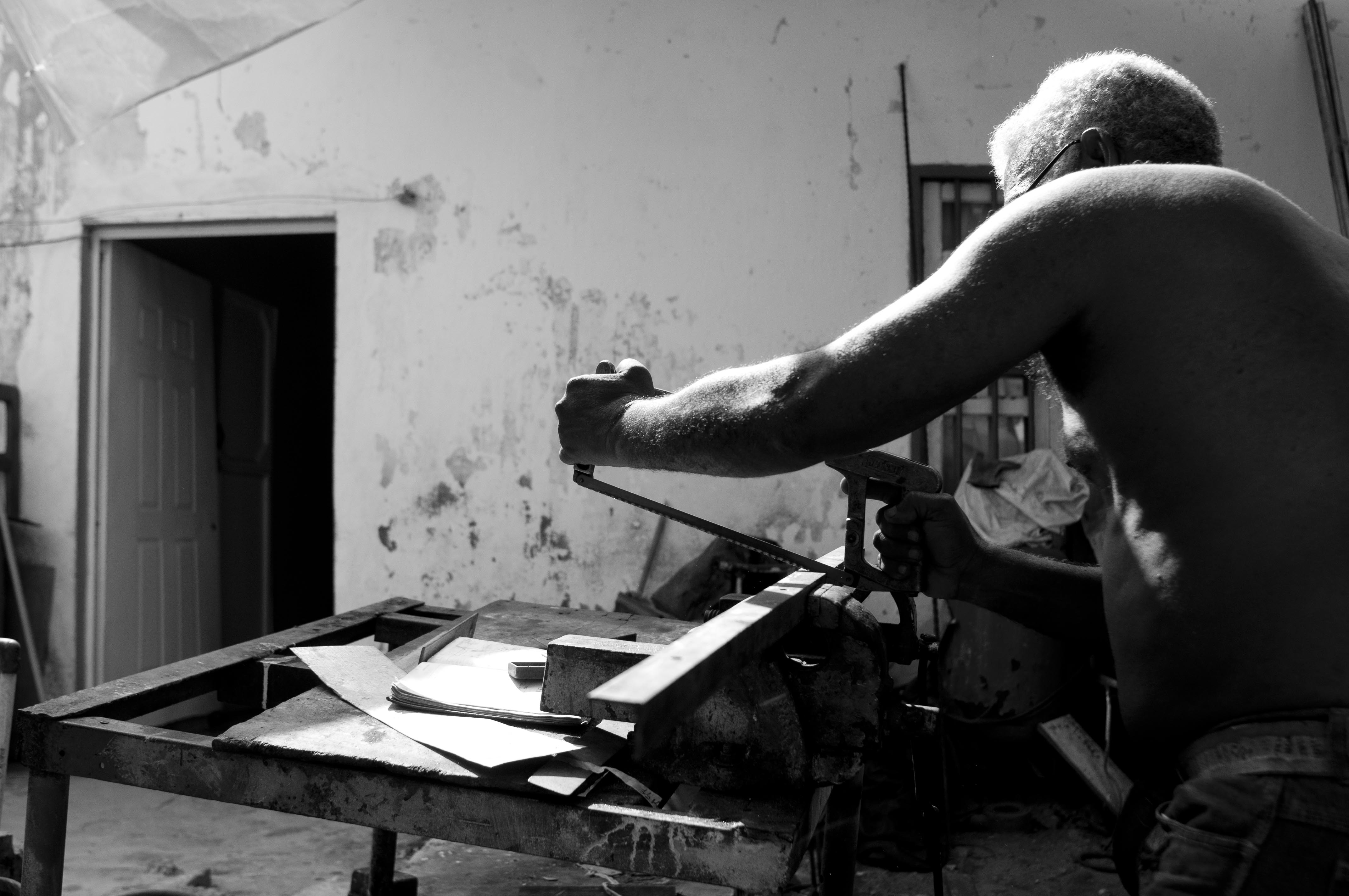
The hot sweat coming through the rugged flannel shirt Ernesto Muñoz was wearing spoke volumes about the man and his dedication to fusing power with elegance: he ripped off the heavy flannel, threw it on a giant stump, studied the piece of iron in his hands, threw the lever on a clamp to secure it, and with the fine teeth of a hacksaw, the blacksmith went into a dizzying spell of thrusts, putting all his might into the beginning of another afternoon building Cartagena.

“Of course I feel powerful,” said Ernesto. He put down the blade and took up a welder’s torch. Blinding white light illuminated his shop. Continue reading on Beacon…


Asphalt Blues: The Streets of Emiliano Villabon

20130824-DSC_0126-2BEACON

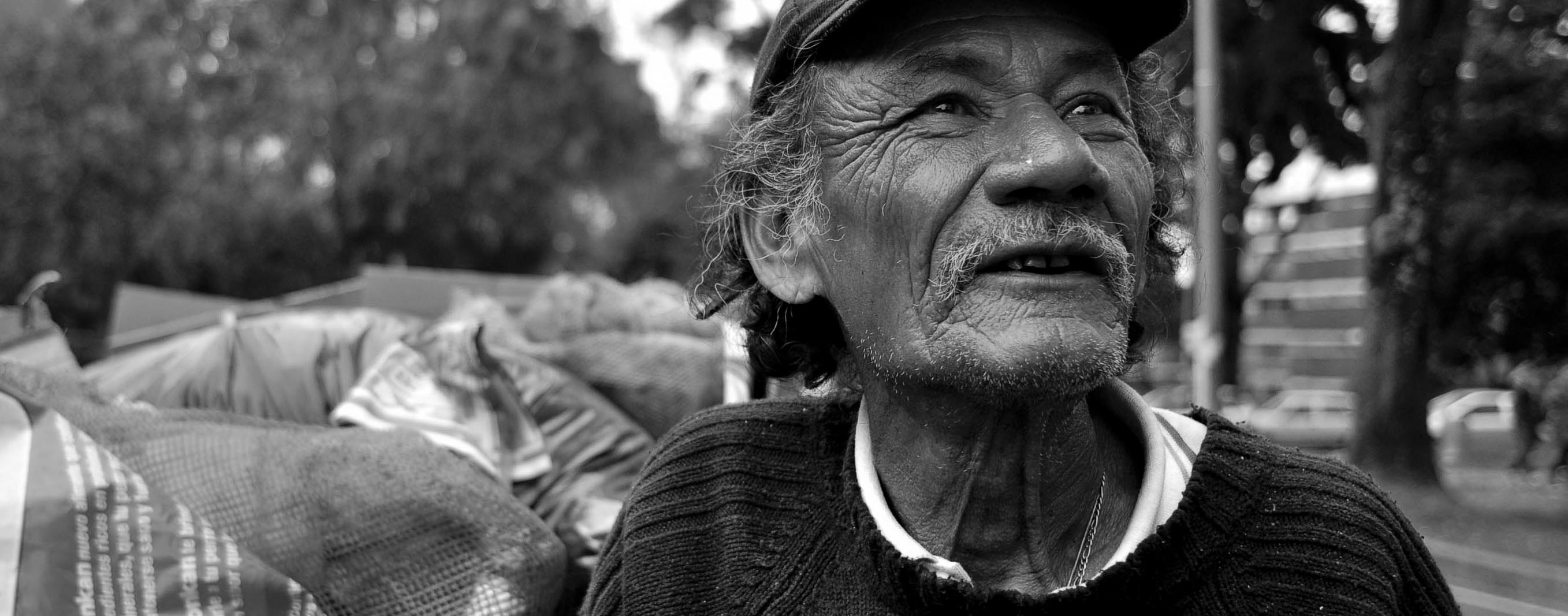
Emiliano got up from the curb and tossed his cigarette to the ground. He went over to his cart and readied himself for the final trek. The two worn wooden handles came up from underneath him and struck him in the soft spot of his underarms. I saw him wince. The creases and wrinkles in his face criss-crossed madly across his calloused skin. For another day, he was a human mule. He will be 64 years old this year.

Emiliano Villabon roams the streets of Colombia’s capital scavenging for trash that he might be able to recycle. He lives close to an urban underworld of crime and drug addiction, but while many recyclers in the city commit themselves to drugs in order to cope with their misfortune, Emiliano likes his streets, stays sober and seems surprisingly proud. Continue reading on Beacon…

Ahead of Election, Colombia’s Santos Signals Tough Stance on Mining

World Politics Review

When he took office in 2010, Colombian President Juan Manuel Santos trumpeted mining as a “locomotive” that would drive the economy forward.

Recently though, the Santos administration dealt a series of harsh blows to the country’s No. 2 coal exporter, Alabama-based Drummond Co., in response to a series of legal blunders committed in 2013. Coming down this hard on a company like Drummond is an unprecedented move for Colombia’s government, signaling that from here on out, multinationals that come to mine the country’s natural resources could face a new, hard-line stance when they don’t play by the rules. Continue reading on WPR…

Are the FARC afraid of a peace agreement?

“The FARC are scared of reaching a peace agreement,” Daniel Pécaut told Cali based newspaper El Pais de Cali in an interview recently.

Pécaut is a French sociologist and historian who has covered Colombia’s armed conflict almost since it started. He went on to add that it would be very difficult to secure a peace deal in the time remaining.

“Yo creo que será difícil en el plazo que queda y es muy difícil con elecciones sin saber nada de los resultados de meses de negociación.
La idea fundamental es que en el país no hay movilización en favor de la paz, son muy pocos los preocupados por la paz y por eso de los dos lados están más o menos aislados.

“I believe that it will be difficult in the time that remains and it’s very difficult with elections without knowing anything about the results of months of negotiation. The fundamental issue is that there isn’t mobilization in favor of peace, very few are worried over a peace deal and for that reason the two sides are getting more and more isolated.”

It’s been nearly one year after members of Colombia’s government and FARC guerrillas met in Havana, Cuba to start peace talks.

How much do Colombia’s victims deserve?

The ringing in the right ear of Edgar Bermudez has not stopped since the former policeman felt an explosion crack open his face, knock him to the ground, blow out his eyes and steal his sight forever. Never, in that horrifying instant, did he lose consciousness. He was 26 years old.

Edgar was stationed in Nariño, a department in the south west of the country, where Marxist guerrilla and Colombian military vie for territory in a half-century armed conflict that has accounted for over 200,000 Colombian deaths. Edgar was part of a special ops team. Their mission was to eradicate coca grown in rebel FARC-held territory. Starting at 1am in the morning, bombs and grenades rained down on him and his battalion. The young policeman watched his friend die. He almost made it through the 6 hour bombardment unharmed. But then there was the explosion.

“The ringing sound bothers me still. It comes and goes though, so not all the time…” says Edgar over hot chocolate in a quiet cafe in Bogotá’s Palermo neighborhood.

image

Former policeman Edgar Bermudez is blind after an explosion took away his sight. photo Wesley Tomaselli

There are other things that bother the 34 year old blind man as well: It bothers him how people don’t watch their umbrellas in the rain. He can’t see them. People don’t pay attention. And the pointed tips strike him in the face as the crowds hurry by. It bothers him that he has to use a cane to get around Bogotá. And it bothers him that victims of the country’s 50-year war don’t get the reparations he thinks they deserve.

How to deal with victims and reparations for their losses is the 5th issue on a 6 point agenda being discuss between members of Colombia and the FARC in Havana, Cuba. Nearly one year on, preliminary agreements on only 1 of 6 points have been reached.

Colombia Looks to Turn Commodities Wealth into Development

Published in World Politics Review

Following a decade-long oil and mining boom, Colombia is facing the challenge of how to harness its energy wealth and push development forward.

Since former President Alvaro Uribe opened up Colombia’s oil and mining sectors in the early 2000s, Colombia has gone from producing just more than 500,000 barrels per day (bpd) in 2002 to nearly 1 million bpd in 2012. Over the same period, it has seen foreign direct investment inflows jump from $2.1 billion to $15.8 billion, more than half of which was destined for the oil and mining sectors last year. Some 68 percent of Colombia’s $369 billion GDP in 2012 came from oil and mining. With the economy growing at 4 percent, the oil and mining boom has left Colombia with enough wealth to make a big difference in its development.

“Part of that growth is coming from a commodities supercycle that has clearly helped Colombia and other Latin American countries,” says Jamele Rigolini, Andean region economist at the World Bank. But growth does not always mean development. For Colombia, structural limitations behind its shining oil and mining sectors could hold development back if the country doesn’t put its energy wealth to good use.

One of those limitations is infrastructure, particularly an outdated transportation network that is eroding Colombia’s competitiveness. Manufacturers pay more to truck their products from the interior to port than it costs to ship those products from port to markets halfway around the world. Julian Trujillo, an executive at industrial adhesives manufacturer Saint-Gobain, says that the government has neglected infrastructure development, letting costs fall on businesses and in turn denting industry’s ability to compete globally.

Jorge Restrepo, professor of economics at Universidad de la Javeriana, agrees. He says that going forward, Colombia has to learn how to use its wealth to develop not just infrastructure, but also education, observing, “Those are major bottlenecks. We’ve tried, but failed. We still don’t know how to do it.”

The key, says Restrepo, is how royalties from the oil and mining sectors are managed. He says that rent-seeking behavior on the local level has gotten in the way of opportunities to reinvest royalties into development. Moving forward, a 2012 reform promoted by President Juan Manuel Santos that moves the control of royalties from local politicians to central authorities could reverse that.

In addition to the need for reforms, Colombia should feel a sense of urgency to diversify its economy. Earlier this year, the International Monetary Fund cautioned that Colombia was particularly vulnerable to a downturn in oil prices, warning the energy-rich country of “overdependence on the volatile commodities sector.” More than 80 percent of Colombia’s exports are commodities right now. If commodities prices take a dive, that overdependence could come back to haunt Colombia.

Where other countries in the region, like Peru and Chile, have taken advantage of China’s commodities binge over the past decade, Colombia seemed to miss the boat. Now, even as China keeps steady with 7 percent growth, Colombia still only exports 5.5 percent of its commodities to the world’s second-largest, and energy-hungry, economy.

Rigolini says that as the commodities supercycle comes to an end, Colombia will have “to find new sources of growth to expand. And moving from a time of growth in commodities to different sources of growth is the most challenging part.”

As for Colombia’s ability to meet that challenge, there are some hopeful signs on the horizon. First, Colombia is a member of the Pacific Alliance, a regional trade bloc made up of Chile, Peru and Mexico that promotes regional free trade. As a member, Colombia is looking to benefit from expanding trade with its partners beyond commodities. If the trade bloc is as good in practice as it sounds in its leaders’ rhetoric, the alliance might be part of the solution for getting Colombia’s shrinking industrial sector going again and spurring growth in other sectors.

It might not be too late for Colombia to take advantage of China as well. China’s appetite for energy is changing, shifting away from high levels of coal consumption toward oil and natural gas, according to Beijing’s 12th Five-Year Plan. That could be an opportunity for Colombia, as right now Colombia’s energy sector is strongly positioned toward the petroleum market, with 50 percent of its commodities exports coming from crude. Last year, President Juan Manuel Santos signed preliminary agreements with China Development Bank for financing a pipeline that would link Venezuelan and Colombian oil with the Pacific coast.

“Infrastructure has to keep up with oil production,” observes Christian Gomez, director of energy at the Americas Society. “So China’s looking at this as an interesting opportunity.”

But feeding China’s new energy appetite is unlikely to be the saving grace for Colombia’s development in the long term. The other crucial ingredient for Colombia’s long-term development is whether the government arrives at a peace deal with the FARC, the country’s largest and longest-standing rebel group. Peace with the rebels would likely mean more security for Colombia’s entire economy, not just its energy infrastructure; guerrilla attacks still set back production. A peace deal could also mean less military funding and more spending on transportation, health and education in the future.

In the meantime, one country in the region Restrepo says Colombia could look to as a role model is Chile, which manages its mining royalties in a way that lets Chileans save for a rainy day and invest in development. Chile has figured out “how to transform their mining royalties into development in science, technology and infrastructure,” says Restrepo. “We envy that here in Colombia.”

Colombia’s boom is still strong, and it still has the potential to open a new chapter for the country’s development. But if Colombia fails to make smart investments and seed new sources of growth, the country’s renewed fortune could slip, making for a lost opportunity and adding regret to envy.

Can cultural tourism clean up Colombia’s image abroad?

published in Seattle Globalist

Once known for brothels and drugs, an old quarter of Cartagena is experiencing big changes as part of a nation-wide cultural makeover.

“Ten years ago there were robberies and prostitutes here,” says Ernesto Muñoz. “But now there are tourists.”

The stern blacksmith turns to us and shows off the iron-forged scrolls in the dim light of his workshop.

He walks down the street from his shop and points out his work: cages, door knobs, gates. He has a reputation when it comes to safeguarding the people of Getsemaní, a working class neighborhood in the old town of Cartagena, Colombia.

But the thing is, safety is not too much of a worry in the neighborhood these days.

The tourism-driven transformation of this neighborhood reflects the challenges that have come with this South American country’s changing image.

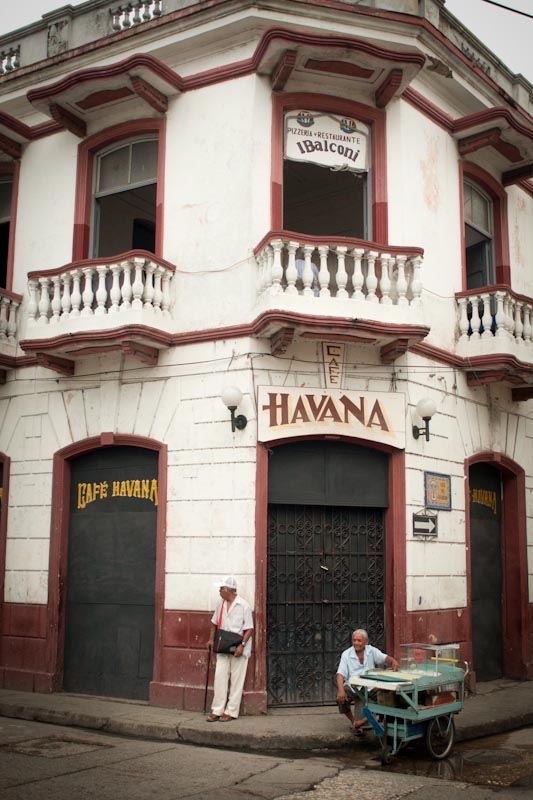
Getsemaní's Cafe Havana, which has hosted celebrities like Hillary Clinton, is symbolic of the challenges of a changing neighborhood trying to hold on to its authentic feel. (Photo by Wesley Tomaselli)

Getsemaní’s Cafe Havana, which has hosted celebrities like Hillary Clinton, is symbolic of the challenges of a changing neighborhood trying to hold on to its authentic feel. (Photo by Wesley Tomaselli)

Some travelers still come for the easy drugs and prostitutes that used to line the neighborhood’s main street.

But more and more, travelers are visiting to meet people like Muñoz and soak up the culture springing up around his workshop.

“And I have no problem with them,” he explains from a plaza outside a worn out yellow church in the center of his neighborhood, where music, soccer games, and street food take over the neighborhood each night.

With $27.8 million in investment this year, Colombia is dressing the city in tourism promotion. The amount invested in Cartagena’s tourism scene outweighed investments in infrastructure and industrial competitiveness, according to figures from Colombia’s Ministry of Commerce, Tourism and Industry.

All that money comes with a new message too.

To combat it’s reputation for cocaine and conflict, Colombia is now promoting the imaginative, literary machinations of national icon Gabriel García Márquez.

In April of this year, Colombia announced its new slogan: “Colombia, Magical Realism”.

Del Morris, a Pacific Northwesterner in his late thirties, escaped to this city from the cold, oil sand country in Northern Canada, where he works as a welder. He came searching for travels that mirror the magical realities Colombia promises. Cartagena had just what he wanted.

“This is a place where I would love to learn ironwork,” Del says, pointing toward the iron scrolls that decorate gates, cages and door features around Getsemaní.

Tourism has helped to boost Colombia’s economy and image over the past decade. Much of the transformation is thanks to former President Alvaro Uribe, whose series of controversial hardline security policies helped turn cities like Cartagena into safe destinations for travelers.

Money is only the first step though.

Cristian Ahumada, director of Ciudad Movil, an arts & culture workshop in Getsemaní, says that there are a lot of foreigners and travelers who come to participate in the neighborhood’s flourishing cultural scene.

He thinks the Getsemaní has the right ingredients to change Colombia’s image.

“It wasn’t always like this. It used to be considered a really dangerous neighborhood.” says Ahumada, who grew up in the city. “But now the main street is filled with hotels and travelers.

But it’s still a delicate issue, he says. According to some residents the neighborhood, known for its sleepy streets drenched in beautiful colonial architecture, is in danger of being overrun by the wave of travelers.

Blacksmith Ernesto Muñoz shows Northwest native Del Morris how to craft a scroll out of metal in his workshop in Cartagena. (Photo by Wesley Tomaselli)

Blacksmith Ernesto Muñoz shows Northwest native Del Morris how to craft a scroll out of metal in his workshop in Cartagena. (Photo by Wesley Tomaselli)

There’s a local population that isn’t in favor of it. Lots of people I know complain about gentrification,” adds Ahumada.

The other problem, of course, is that there are still foreigners who come to Colombia’s Caribbean city for its vices.

In April of 2012, a scandal broke out when 13 C.I.A. Secret Service agents enjoyed a night of drunken debauchery involving prostitutes and booze during a visit by President Barack Obama for the Summit of the Americas.

Cartagena taxi drivers report that they still encounter plenty of tourists in search of drugs and prostitutes, not just beaches and historical sites.

Prostitution is legal in Colombia in designated tolerance zones. But it still taints the country’s image.

Ahumada says that for the most part, however, travelers who come to his city join in on the throng of arts, music and culture that gives it its spirit.

It’s a point of cultural exchange,” he says.

Inside Ernesto Muñoz’s shop, Del Morris picks up the blacksmith’s scrolls and admires them. The forge is hot, and sweat pours off hard, serious faces. Muñoz is proud of his work. The pounding of the hammer against the anvil starts up again.

The Canadian welder says he feels inspired after visiting Ernesto’s forge. He wants to bring back what he learned to Vancouver and someday start his own blacksmithing shop.

Visitors like Morris may be the key to nurturing Getsemaní’s art, music and craftsmanship.

But if tourists make different choices with their money, the local culture might just fall prey to gentrification and disappear.

Colombia’s farmer strike causes shortages

Watch farmers and police clash in central Colombia via Al Jazeera.

Farmers say the government’s economic policies are ruining them by causing a flood of contraband and cheap imports in the market.

The footage here shows farmers who have thrown out huge amounts of fruits and other agricultural products in protest of their economic conditions.