Category: Politics
Venezuela expats are tweeting the way for embattled protesters
Global Post
BOGOTA, Colombia — As anti-government protesters descended on Caracas’ main plaza this week, marcher Eiker Ramirez called a Venezuelan living in neighboring Colombia and asked her what was happening.
His friend here, 24-year-old university student Yoselie Gonzalez, checked her Twitter feed. Continue reading at Global Post…
Land reform, decreased inequality minimum demands for peace: FARC
January 15th, 2013 MEDELLÍN (Colombia Reports) – Colombia’s largest rebel group, FARC, on Monday set agrarian reform and a decrease in inequality as their minimum demands for reaching a peace agreement with the government.
In an interview sent to Colombia Reports, the guerrilla’s lead negotiator “Ivan Marquez” — whose real name is Luciano Marin — laid out their principal demands in negotiations.
“The minimums? Comprehensive rural reform and the reversal of the Gini coefficient,” said Marquez. The Gini coefficient is the main statistical measure of a country’s inequality. According to the World Bank, Colombia currently has the seventh worst in the world, comparable with Haiti and Angola.
“There’s a common diagnosis on the situation of misery that, like a weed, invaded the Colombian countryside. The Gini coefficient of 0.89 is a mirror that reflects the terrible inequality that is prevalent in this sector. The government doesn’t even have the strength or the arguments to challenge those sad figures of injustice,” explained Marquez.
Though the Colombia government has claimed that its economic model is not up for debate in the peace talks, Marquez insists that omitting it from the talks is “not consistent with the spirit of the General Agreement of Havana.”
“It is impossible for the deepening of neoliberal policy, promoted by [President Juan Manuel] Santos, and the delivery of territory to the multinational extractive industry to escape the discussion about land access and use, and food sovereignty,” said the rebel negotiator.
“Dignified life in the cities depends on rural stability, and vice versa. It should strengthen the symbiotic relationship so that Colombia moves forward. We must democratize national life, beginning with the democratization of land ownership,” Marquez claimed.
Just prior to the restart of negotiations on Monday, the Colombian government and FARC studied more than 500 proposals from citizens, gathered during a forum hosted by the U.N., along with input from university professors, experts, and peace commissions regarding the contentious matter of land reform.
Marquez said that all input from the committees would be given serious consideration by the FARC delegation, declaring that “they contain the hope of solving the problem that many rural people have longed for…this is the key to peace.”
In the interview, the rebel leader showed a willingness to reach a peace agreement before November, the deadline imposed by President Santos, but said he refused to prematurely sign a deal.
“Although we’re in no electoral hurry, we hope to be able to have an integrated agrarian reform before November,” Marquez said.
Both the government and rebels have labeled land reform as crucial for the signing of any treaty that would put an official end to almost 50 years of fighting — the longest-running civil conflict on the continent.
During his Christmas address, Santos spoke of the importance of reaching social justice, signaling a willingness to confront the same issues Marquez speaks of in future rounds of talks. In a speech towards the end of December, the Colombian presidentspoke of “a true peace; a peace that is not just the end of violence but also progress towards a greater social justice.” The FARC, ever since peace talks began, have stressed the necessity for peace “with social justice.”
Nevertheless, according to Marquez peace is not yet within reach.
“We are taking the first steps [that] we all know are complex. We need navigation equipment. To reach our destiny of peace we need GPS and compass, statistics, figures and land registries. But in Colombia this support does not exist or is insufficient. We need to know what is going to be redistributed, returned and formalized. It can’t just be wastelands.”
The sergeant in his labyrinth: José Guarnizo’s story
January 8th, 2013 MEDELLÍN (Colombia Reports) – The Odyssean story of Sergeant Jose Guarnizo, a former hostage now condemned for participation in a massacre, has shed light on the extraordinary complexity of Colombia’s half-century armed conflict.
Guarnizo fell into the hands of the country’s largest guerrilla group, FARC, in July 1997 in the northern Antioquia department. Along with a handful of high-ranking officials, the sergeant was taken captive, and remained a hostage for six years until May 2003 when he was rescued by security forces. The rescue, however, did not run smoothly, and ended in the deaths of other hostages, including former Defense Minister Gilberto Echeverry and the then-governor of Antioquia, Guillermo Gaviria.
Then, two years after his release, Guarnizo was convicted for his role in a 1992 massacre of seven farmers in the central Meta Department. The courts sentenced him to over 33 years in prison.
But three years later, in 2008, a local court in the Meta Department acquitted him on the grounds that it was impossible for Guarnizo to have been in the town during the time of the murders.
Liberation was fleeting for the sergeant — just before courts entered recess in December 2011, the sentence was reinstated.
“They have not issued the arrest warrant, but they left me with a sentence of 34 years for the process that I had won in the first instance,” Guarnizo told the Associated Press.
Much like the Sergeant’s story, Colombia’s half century of armed conflict between leftist guerillas, illegal paramilitary groups and the Colombian state is like a labyrinth.
Where it will end is hard to see.
Tanja Nimeijer set to join Peace Talks in Havana
Tanja Nimeijer, a Dutch citizen, is set to join the Peace Talks between the FARC and the Colombian government in Havana as a representative for the Marxist guerrillas, according to the Colombian news magazine Semana.
Nimeijer joined the FARC after working as an English teacher in the city of Pereira. The teacher-turned-guerrilla says that she chose Colombia purely by coincidence because it offered an opportunity to fulfill a university internship requirement.
Nimeijer’s university instructors observed strong left-leaning political inclinations during her studies as a student of Romance literature in the Netherlands.
The message about the Dutch woman’s participation was reportedly not received well by the Colombian government because Nimeijer is not a Colombian citizen.
After concluding a round of press conferences in Oslo, Norway, the Peace Talks will move to Havana, Cuba. The talks between the FARC and the Colombian government began in secrecy in February of this year, and the intention to engage was made public by Juan Manuel Santos in August.
The armed conflict between the FARC and the Colombian state began in 1964.
Student Protests Against Education Policy Turn Ugly in Santiago
In this video, aggressive clashes between Chilean students and police take place along La Alameda, one of Santiago’s major avenues, during part of a widespread protest against recent motions issued by billionaire President, Sebastian Piñera, that regard how to ease the costs for students while keeping intact a privatized system of education put into place during Augusto Pinochet’s 1973-1990 rein.
According to the Santiago Times, “encapuchados” battled with police in a series of violent encounters, calling for an end to what they perceive to be an education system that separates students based on socioeconomic factors. Reuters reports that one student suffered fatal wounds after being shot in the chest by police, and that more than 30 police were left injured. Some 1,300 of an estimated 200,000 protesters have been detained.
The BBC reports that Mr. Piñera recently appeared on national television to outline tax reforms expected to raise around $700m USD, much of which will be funneled to the country’s education system.
A disgruntled posture toward education policy in Chile has been maintained by student activists for more than a year now, but despite Piñera’s reforms, Chilean students are still left unsatisfied, frustrated and increasingly irate. What they fundamentally want is more regulation in the private sector and to put an end to for-profit education organizations.
Student leader Gabriel Boric told Spain’s Efe news agency, “We will carry on making history… We students will not give up the fight to make education a public right.”
Julian Assange Seeks Asylum in Ecuador
According to the BBC, Julian Assange is seeking political asylum in Ecuador. Ecuador’s foreign minister, Ricardo Patino, says that Assange is being held by the Ecuadorean embassy in London and will remain under protection until a decision is made.
After being arrested in 2010 for disseminating a massive number of US diplomatic cables through a website called Wikileaks, Assange was threatened with extradition claims to Sweden and the US. Now, for fear of facing allegations in Sweden, where he could see a subsequent extradition to the US, Assange has applied for asylum in Ecuador.
The Ecuadorean government says that “the decision to consider Mr Assange’s application for protective asylum should in no way be interpreted as the Government of Ecuador interfering in the judicial processes of either the United Kingdom or Sweden.” However, according to a Guardian report, “assessments for asylum requests take priority over extradition claims” under UK law.
Daniel Schmitt, a co-founder of Wikileaks, says that Assange is “one of the few people who really care about positive reform in this world to a level where you’re willing to do something radical to risk making a mistake, just for the sake of working on something they believe in”. The Economist Intelligence Unit gives a democracy rating of 5.72 (89) to Ecuador, the country where Assange seeks asylum. The US (18th), where Assange faces allegations, earns top tier rank – 8.90.
Ecuador’s deputy foreign minister has offered the possibility of asylum in order to show favor for Assange and his intention to present the information he has. However, President Rafael Correa denied that statement. Until the embassy makes a decision, Assange will remain inside the safety of embassy grounds – out of reach of the hands of London police, Sweden and the US.
Two South East Asian Nations Splash
On July 7th, The Economist reported that Vietnam and China reignited a wave of nasty signals toward each other over oil rights in the waters surrounding a string of archipelagos in the South China Sea.
Until June 21st, the Spratly and Paracel islands enjoyed a momentary calm after China and the Phillipines shouldered off an impending skirmish. But the calm did not last long. Vietnam re-asserted its claims to the islands through a parliamentary decree, to which China responded vehemently, claiming that Vietnam had violated its sovereignty.
In turn, the Chinese government immediately upgraded the status of the municipality that governs the Spratly and Paracel islands, giving it more jurisdictional leverage. Worrying mounted again when CNOOC, a state-directed oil firm, declared that it was opening bids for drilling in a zone not too far offshore from the islands to which Vietnam lays claim.
The two countries have a wary eye on each other, but despite the boundary scuffle, neither country seems too keen to break diplomacy and act aggressively. Hilary Clinton is scheduled to visit Phnom Penh in mid-July to discuss security in the region with Yang Jiechi, China’s foreign minister. China does not want to tarnish its image with an act of mischief. But under the surface, back at home, China’s newspaper Global Times is less restrained, saying Vietnam should be punished for its advance on China’s sovereignty.
Hong Kong Commits a Slip of The Tongue
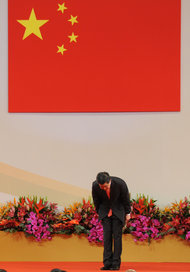
According to a View from Asia post, Hong Kong’s chief executive, Leung Chun-ying, was sworn in today with a nice little inaugural speech, which he gave in Mandarin Chinese. Mandarin is the official dialect of mainland China. The most widely spoken language of Hong Kong is Cantonese, which is spoken by 89% of its inhabitants. It seems that Mr. Leung has committed a slip of the tongue.
 Wes Michael Tomaselli